AIN Hire
Bahasa Indonesia voice-screening prototype with bounded interviews, evidence-backed AI scoring, and required recruiter sign-off.
Overview
AIN Hire is a mobile-first prototype for screening entry-level direct-sales candidates through a short Bahasa Indonesia voice interview. It captures consent, runs a structured conversation, scores the resulting transcript against a sales competency rubric, and gives recruiters a ranked, evidence-rich shortlist to review.
The project is deliberately more than a chatbot. It is a controlled decision-support workflow with explicit boundaries around what the AI can ask, how results are scored, what evidence is retained, and where a human must make the final call.
Problem / Context
High-volume entry-level hiring creates a practical screening problem: recruiters need a consistent first pass without turning the process into an opaque automated rejection system. A useful prototype therefore needed to balance four concerns:
- a natural voice experience for candidates,
- repeatable interview coverage across sessions,
- structured evidence for recruiters,
- and clear human accountability for the final outcome.
What I built
- A candidate-facing Streamlit flow with consent, turn-based audio, speech provider interfaces, and a text fallback for local testing.
- A deterministic interviewer state machine with bounded probing, objection role-play, integrity and coachability checks, and a defined wrap-up.
- A separate scorer interface with a pinned Gemini path for Google Cloud mode and a heuristic path for no-cost local demos.
- A validated
InterviewResultschema with competency scores, evidence quotes, knockout rules, and a ranking helper. - Local JSON persistence plus Google Cloud Storage and BigQuery adapters that preserve the same logical data model.
- A recruiter dashboard with ranked candidates, transcripts, evidence, audio review, and explicit human sign-off controls.
- Tests for schema validation and interview-state progression.
Architecture
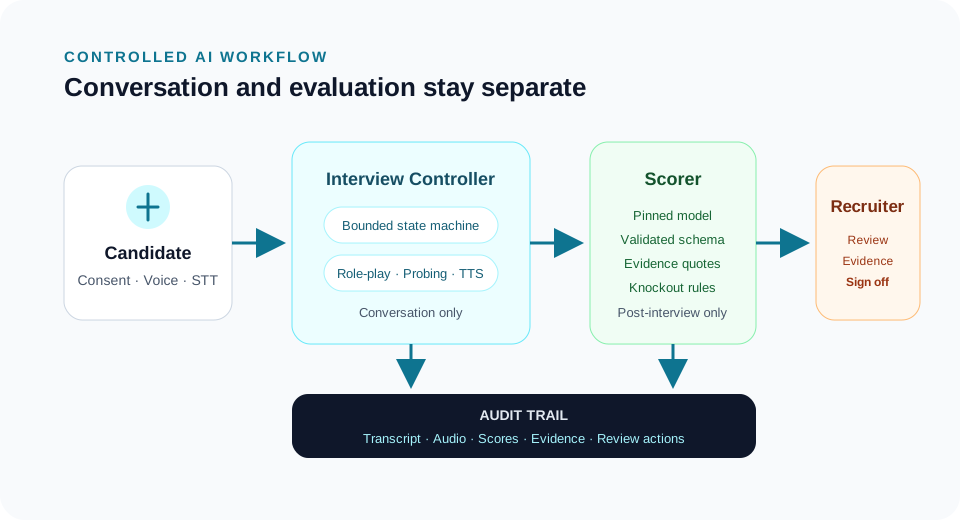
The conversational path and the evaluation path are intentionally separated. The interviewer gathers evidence through a constrained state machine; only after the interview is complete does the scorer produce structured results. Recruiters then review the evidence and retain final authority.
Responsible automation decisions
Deterministic control around the model
The interviewer does not get an open-ended mandate. A state machine controls which stage is active, how much probing is allowed, and when the interview must move forward. This makes sessions easier to test and reduces behavioral drift.
Evidence before ranking
Competency scores are paired with evidence from the transcript. The dashboard exposes those quotes and the full conversation so a recruiter can inspect why a score was produced instead of trusting a number in isolation.
Human sign-off stays mandatory
The prototype supports ranking and decision assistance, but it does not make an irreversible hiring decision on its own. Recruiter sign-off is required before final rejection.
Speech style is not a penalty
Accent, dialect, code-switching, and informal speech are explicitly excluded as scoring penalties. The rubric focuses on job-relevant evidence rather than presentation style that could create unfair proxies.
Key engineering challenges & solutions
- Challenge: Keeping AI-led interviews consistent without making them feel like a static form.
Solution: Combined a deterministic stage machine with bounded model-generated prompts and follow-ups. - Challenge: Avoiding self-evaluation by the same component that conducts the interview.
Solution: Separated interviewer and scorer interfaces, prompts, and execution timing. - Challenge: Supporting realistic development without provisioning cloud resources immediately.
Solution: Mirrored the production-oriented interfaces with local storage, heuristic scoring, and provider stubs. - Challenge: Giving recruiters a useful result instead of an opaque score.
Solution: Preserved transcripts, evidence quotes, competency-level scores, knockouts, and review actions as one audit trail.
Current status
The v0 prototype supports a full local demonstration and includes adapters and deployment helpers for a Google Cloud path. Cloud infrastructure is intentionally not created by the repository itself; provisioning and deployment remain explicit approval steps.